
 VERY BERRY
£22.00
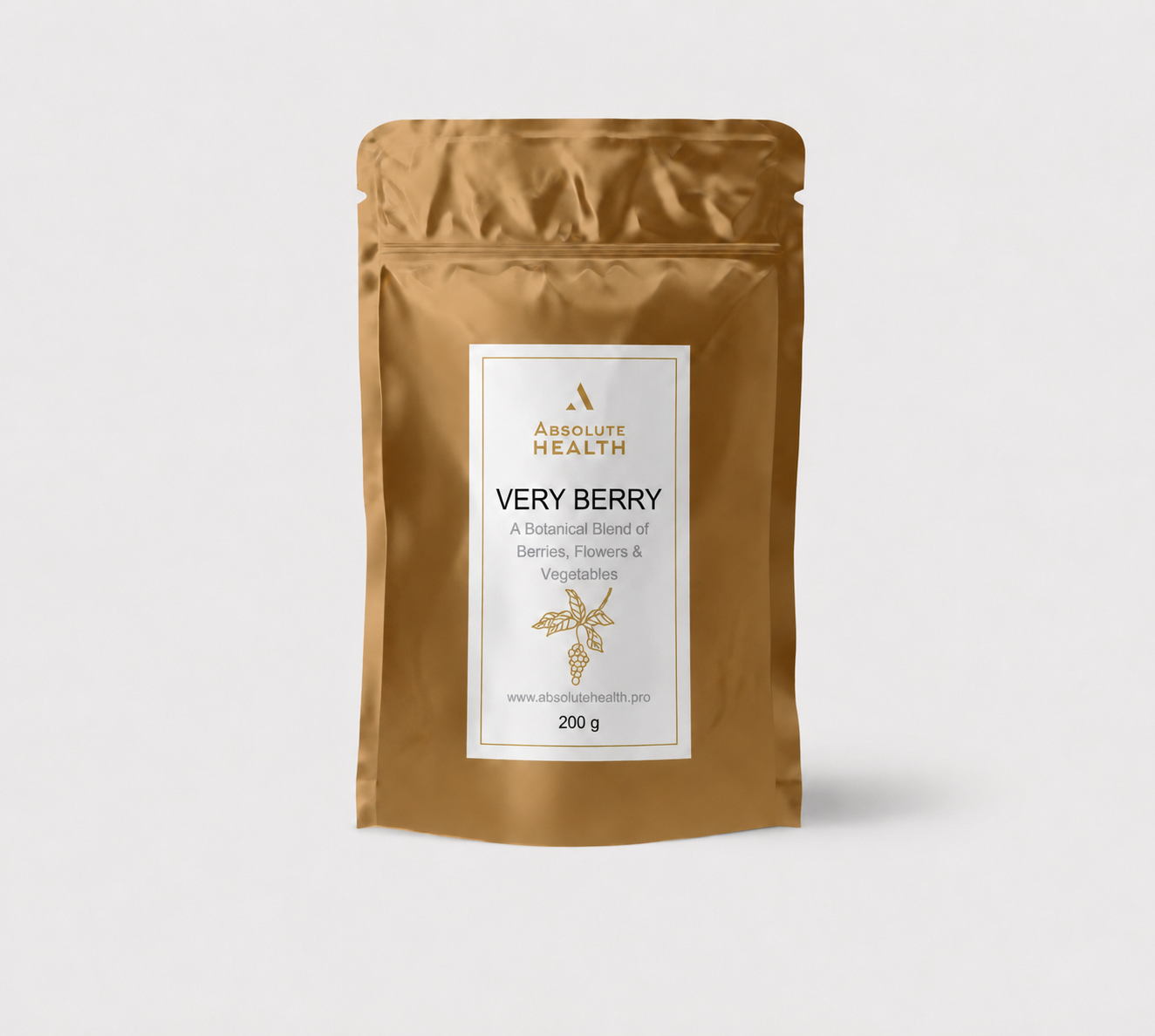
Very Berry is a whole-food superfood blend of ten organically grown dried botanicals, chosen specifically for the breadth and diversity of their phytonutrient profiles. The deep purples, reds and vivid oranges of these ingredients are not incidental. They are the visual expression of pigment compounds called polyphenols: anthocyanins give bilberry and blackcurrant their near-indigo depth; betalains account for the crimson of beetroot; carotenoids underlie the orange of sea buckthorn; ellagitannins give raspberry its colour.
Rather than providing a high dose of any one nutrient, Very Berry is designed to bring exceptional botanical diversity to the daily diet, reflecting the growing scientific consensus that a wide variety of whole-plant foods provides the richest possible foundation for long-term wellbeing. Versatile, vivid and complex in flavour, it integrates easily into water, smoothies, porridge, yoghurt and more.
A staple food of indigenous Amazonian peoples for centuries, açaí is harvested from the tall açaí palm and dried for preservation. Its near-black colour reflects an extraordinarily dense anthocyanin content, predominantly cyanidin-3-glucoside and cyanidin-3-rutinoside. Unusually for a berry, açaí also provides oleic acid (a monounsaturated fatty acid), phytosterols and small amounts of protein alongside its polyphenol content.
Journal of Agricultural and Food Chemistry (2006): açaí demonstrated one of the highest antioxidant capacities of any food tested by ORAC methodology, attributed to its anthocyanin and polyphenol density. Nutrition Journal (2011): daily consumption of an açaí-based preparation significantly reduced markers of oxidative stress and improved metabolic parameters over 30 days.
Cultivated since at least Roman times, beetroot is one of the few food plants whose colour comes not from anthocyanins but from betalains: nitrogen-containing pigments absent from virtually all other ingredients in this blend, including betacyanins (red-purple) and betaxanthins (yellow). Beetroot is also a naturally occurring source of dietary nitrate, folate, manganese and potassium.
Journal of the Academy of Nutrition and Dietetics (2012): a review highlighted beetroot’s betalain content and dietary nitrate as nutritionally active components with evidence across circulatory and exercise physiology research. Food Chemistry (2018): dried beetroot powder was found to retain a high proportion of its betalain content and antioxidant activity, confirming its value in dried blends.
One of the most comprehensively studied functional berries in European nutritional research, blackcurrant is exceptionally rich in anthocyanins (particularly delphinidin and cyanidin glycosides) and contains some of the highest recorded levels of vitamin C of any European berry. Traditionally used for winter immunity and throat health across Britain and Scandinavia, the seeds also provide gamma-linolenic acid (GLA), an omega-6 fatty acid.
British Journal of Nutrition (2016): Blackcurrant consumption was associated with reduced oxidative stress and inflammation markers in athletes. European Journal of Nutrition (2014): blackcurrant extract improved glycaemic response parameters and supported cardiovascular health markers in healthy adults.
The wild European bilberry is nutritionally more concentrated than the cultivated blueberry and has been used in traditional Northern European medicine for centuries. Its dark flesh (unlike blueberries, which are pale inside) reflects that anthocyanins permeate the entire berry. More than 15 individual anthocyanins have been identified in bilberry, alongside tannins, flavonols and hydroxycinnamic acids.
Journal of Agricultural and Food Chemistry (2004): bilberry was found to have among the highest total anthocyanin content of any European berry tested, with a particularly diverse individual anthocyanin profile. Nutrients (2017): a review found consistent evidence across multiple studies for beneficial effects on glycaemic markers and vascular function.
One of the most extensively researched small fruits in nutritional science, cranberries are uniquely rich in A-type proanthocyanidins, a structurally distinct form of this polyphenol class found in very few other foods. Native American peoples used cranberries as both food and wound care for centuries. The berry also provides vitamin C, vitamin E, manganese and dietary fibre.
American Journal of Clinical Nutrition (2016): a meta-analysis found consistent evidence that cranberry products reduce the frequency of urinary tract infections in women with a history of recurrent UTIs, attributed to its unique proanthocyanidin structure. Journal of Nutrition (2011): cranberry consumption was associated with significant improvement in HDL cholesterol and reduced inflammatory markers in a randomised controlled study of overweight adults.
Dried hibiscus calyces are among the most polyphenol-dense floral ingredients in the world, used as a vivid culinary ingredient and traditional botanical preparation across tropical cultures. Their primary anthocyanins are delphinidin-3-sambubioside and cyanidin-3-sambubioside, responsible for their striking deep crimson colour. Hibiscus also contributes vitamin C, organic acids and quercetin.
Journal of Human Hypertension (2010): a randomised trial found that hibiscus tea consumption resulted in a significant reduction in systolic blood pressure in adults with pre-hypertension. Food Chemistry (2014): The anthocyanin content of dried hibiscus calyces was well preserved during standard drying and storage.
One of Europe’s most historically significant botanical vitamin C sources, rosehip has been used since the 17th century as an autumn and winter health preparation. Alongside vitamin C, it provides carotenoids including lycopene, rubixanthin and beta-carotene, plus the flavonoid tiliroside. In Scandinavia, rosehip soup (nypon) remains a beloved cultural staple.
Phytotherapy Research (2018): rosehip extract significantly reduced C-reactive protein and improved joint function scores over a 12-week study. Journal of Medicinal Food (2017): improvements in skin hydration and elasticity were documented in women taking rosehip extract, attributed to its vitamin C and tiliroside content.
Known in Chinese as wu wei zi (“five flavour berry”), schisandra is unique in expressing all five primary tastes simultaneously. It has a 2,000-year history in Traditional Chinese Medicine as an adaptogenic tonic, traditionally used to support energy, mental clarity and resilience. Its primary active compounds are schisandrins, a class of lignans found in very few other plants.
Evidence-Based Complementary and Alternative Medicine (2014): a systematic review summarised evidence for schisandra’s adaptogenic properties, with particular reference to mental endurance, liver enzyme markers and stress-response parameters. Chinese Journal of Natural Medicines (2018): schisandrin compounds were identified as antioxidants supporting hepatic detoxification enzyme activity.
Alongside its vitamin C, manganese and dietary fibre, raspberry is one of the richest dietary sources of ellagitannins, a class of polyphenols that gut bacteria convert into urolithins. These compounds attract significant research interest for their role in cellular health and healthy ageing. Raspberries also provide anthocyanins and flavonols including quercetin and kaempferol.
Food Chemistry (2016): dried raspberries retained a high proportion of their ellagitannin and anthocyanin content, confirming their value as a concentrated polyphenol source. Advances in Nutrition (2019): a review noted increasing evidence for the role of urolithins in supporting healthy ageing processes at a cellular level.
The nutritional outlier of the berry world. Sea buckthorn’s striking orange-gold colour comes from an extraordinary concentration of carotenoids (beta-carotene, zeaxanthin and lycopene), making it one of the richest plant sources of these compounds. It also provides vitamin C at several times the concentration of oranges, vitamins E and K, omega-3, omega-6 and the exceptionally rare omega-7 fatty acid (palmitoleic acid). It has been used in Tibetan and Mongolian traditional medicine for centuries.
Food Research International (2013): sea buckthorn was characterised as an exceptional source of fat-soluble vitamins, carotenoids and rare fatty acids compared to any other commonly consumed berry. Journal of Ethnopharmacology (2017): a comprehensive review documented evidence for sea buckthorn’s role in skin health, liver support and cardiovascular nutrition.
Very Berry is assembled around the principle of polyphenol diversity. Each ingredient contributes a distinct class of compounds that the others cannot: açaí and bilberry bring dense anthocyanin matrices; cranberry its uniquely structured A-type proanthocyanidins; sea buckthorn its fat-soluble carotenoids and rare fatty acids; schisandra its lignans; raspberry its ellagitannins; beetroot its betalains, a compound class absent from every other ingredient in this blend.
Hibiscus, rosehip, and blackcurrant each contribute to the blend’s vitamin C content through distinct botanical sources, creating multiple overlapping whole-food sources of this single nutrient. From a food science perspective, consuming a broad range of polyphenol classes in a single serving is thought to support the gut microbiome more diversely than a high dose of any single compound, because different microbial communities metabolise different polyphenols in different ways. Very Berry is, in this sense, a tool for botanical breadth.
Very Berry is designed to be versatile. It can be stirred into water, blended into smoothies, or folded into food.
100% natural and organic berries.
A vibrant organic superfood blend of ten whole dried botanicals: açaí berry, beetroot, blackcurrant, bilberry, cranberry, hibiscus flower, rosehip fruit, schisandra berry, raspberry and sea buckthorn berry. Designed to bring exceptional botanical diversity to the daily diet, it delivers an extraordinary breadth of naturally occurring polyphenols, anthocyanins, carotenoids, betalains and vitamin C from multiple whole-plant sources.
Açaí berries (organic), beetroot (organic), blackcurrant (organic), bilberry (organic), cranberry (organic), hibiscus flowers (organic), rosehip fruit, schisandra berries (organic), raspberry (organic), sea buckthorn berries (organic).
This product is a botanical superfood blend, not a medicine. Food supplements should not replace a varied, balanced diet and a healthy lifestyle. If you are pregnant, breastfeeding, taking prescription medication or have a diagnosed health condition, please consult a qualified healthcare professional before use.
£22.00
VERY BERRY